
Shidong Miao Dress: Monumental Silverwork and Festival Embroidery
Among the regional Miao traditions documented in this series, Shidong is one of the clearest examples of how textile and metalwork can operate as one visual system.
Official intangible cultural heritage documentation for Taijiang describes Miao embroidery as an important part of dress and identifies Shidong as one of the main areas where this embroidery tradition is practiced. It also records a wide range of techniques in Taijiang, including flat embroidery, split-thread embroidery, braid embroidery, and coiling methods.
The photographs here add another dimension: silver.
A ceremonial architecture of silver
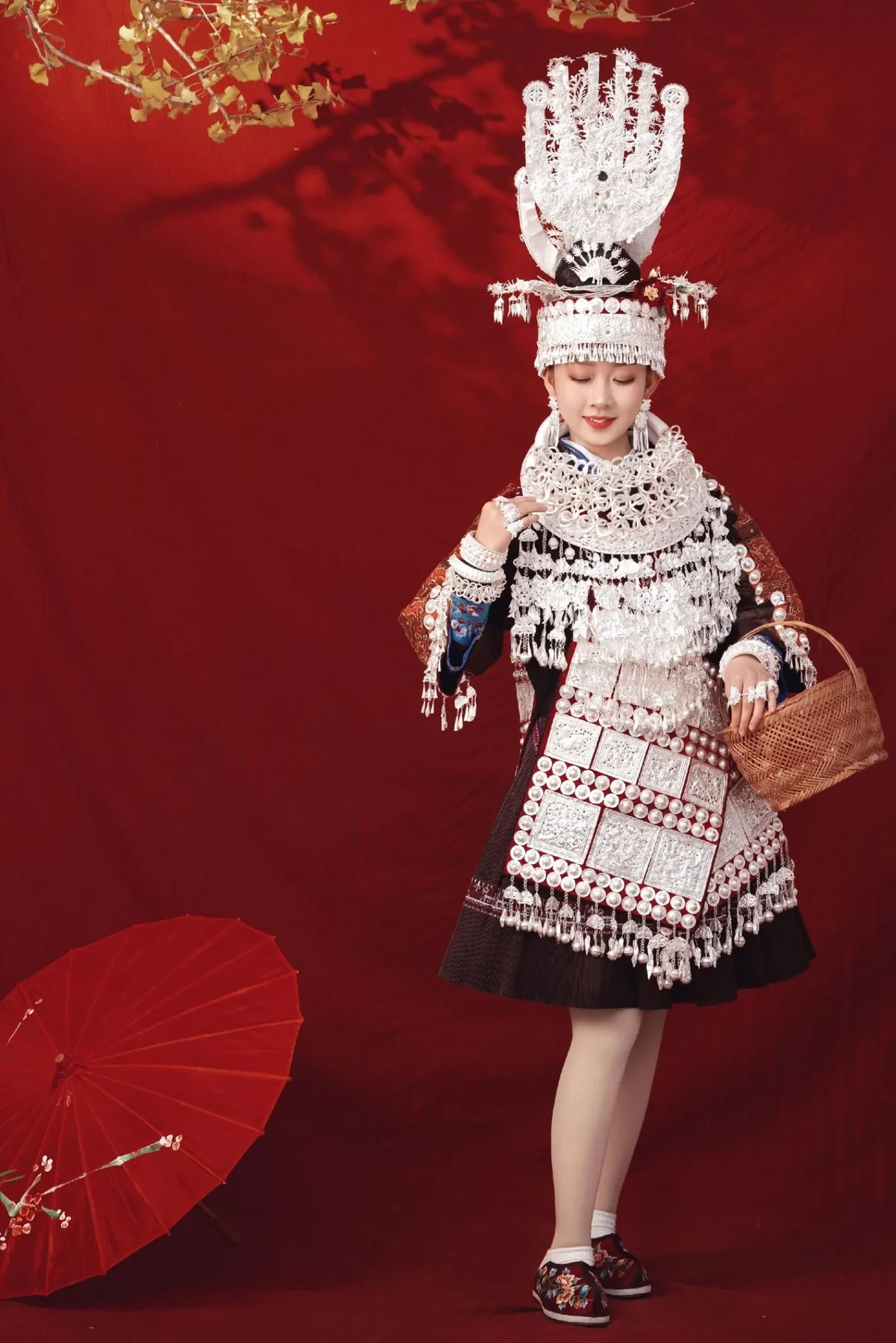
In the Shidong studio images, silver does not simply sit on top of the garment. It creates structure. A tall headdress establishes the upper outline, neck ornaments create layered horizontal forms, and rows of plaques and pendants give the torso a dense reflective surface.
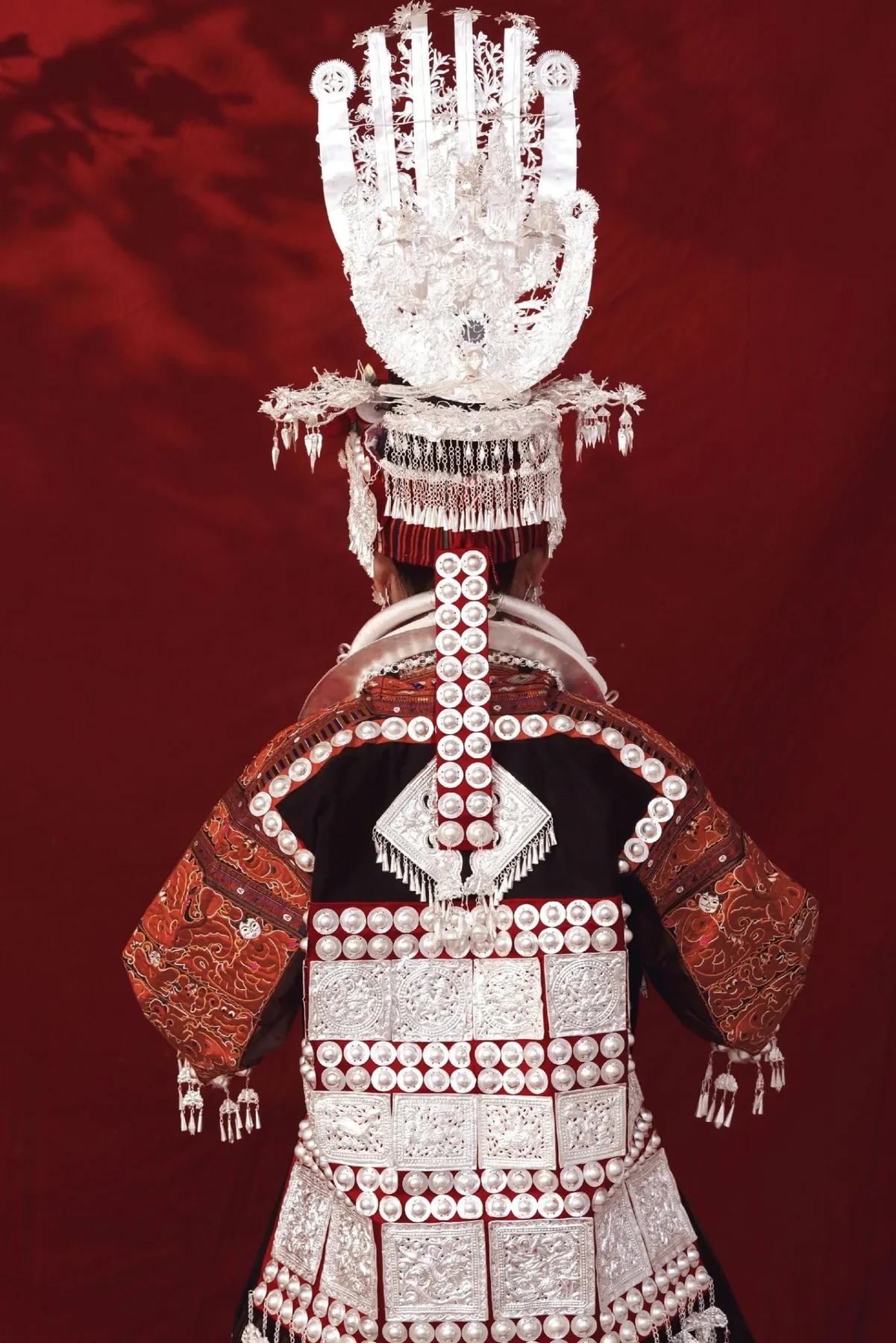
The back view is just as important. It shows how the visual logic continues behind the wearer and confirms that the dress was conceived as a complete three-dimensional composition.
The Guizhou Provincial Museum has specifically highlighted Shidong silver objects in exhibitions on Guizhou silver culture. Such collections help demonstrate how regional silver traditions developed distinctive forms rather than one standardized “Miao silver” style.
Embroidery remains essential
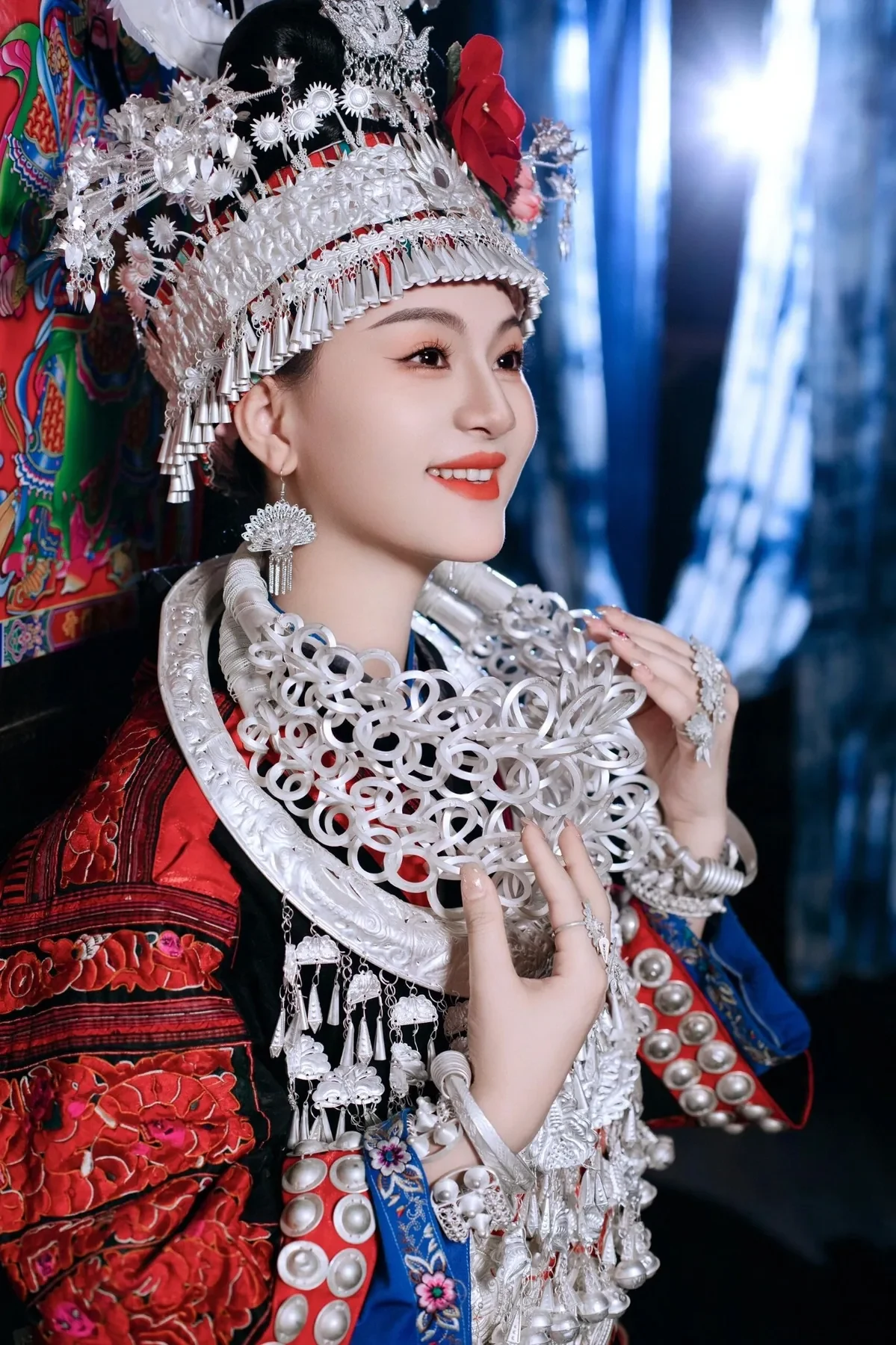
The volume of silver can easily dominate the first impression, but a close look at the sleeve image returns attention to textile.
The embroidered panel uses strong warm tones, outlined figures and curving forms, and a dense composition. Whatever the specific reading of each motif, the important point is that the embroidery carries visual information that remains legible even beside heavy silverwork.
National heritage documentation describes Taijiang embroidery patterns as carriers of cultural memory and migration history and notes that Miao dress has sometimes been described as a “history worn on the body.” This is a useful phrase only if handled carefully: it does not mean every visible motif has one fixed translation. It means clothing can preserve historical and group identity through a visual system transmitted across generations.
Front, back, and detail
For this reason, we have organized the Shidong image group around three viewing distances.
At full length, the viewer sees proportion and ceremonial impact.
From the back, the construction and distribution of silver become clearer.
At close range, the sleeve and collar reveal the haoverall brilliance.
This method of documentation is important for any heritage archive. A single portrait may be beautiful, but it is not enough to record a complex dress tradition.
Why silver moves
Hanging chains, bells, pendants, and plaques change as the wearer moves. They reflect light, overlap, and create sound. Museum exhibitions on Guizhou silver culture emphasize regional variation in the form, quantity, and ornament of silver pieces and describe the strong visual importance of abundant silver in ceremonial dress.
This movement means a still photograph is only one moment in the life of the object.
When we document Shidong dress, we are therefore recording both a material object and the possibility of motion: how the pieces would shift in procession, festival, dance, or gathering.
Living craft, not an anonymous style
The word “traditional” can make heritage sound distant. In reality, embroidery and silverwork survive because people continue to make, wear, teach, repair, and value them.
For AETHNO, Shidong is not presented as a generalized ethnic aesthetic. It is identified by place, documented through multiple angles, and connected to the craft traditions recognized in Taijiang.
That regional precision matters. It is how a beautiful image becomes a cultural record.
Continue exploring: What Is Miao Embroidery? · Jianhe Miao Dress: Silverwork, Red Geometry, and Regional Identity
Shop AETHNO: All products | Women | Men | Kids | Hmong New Year 2026 | Wholesale